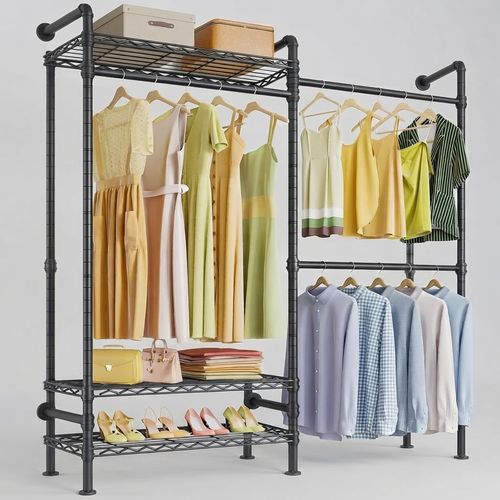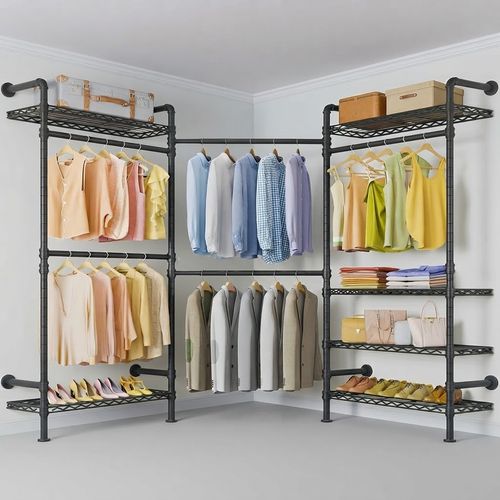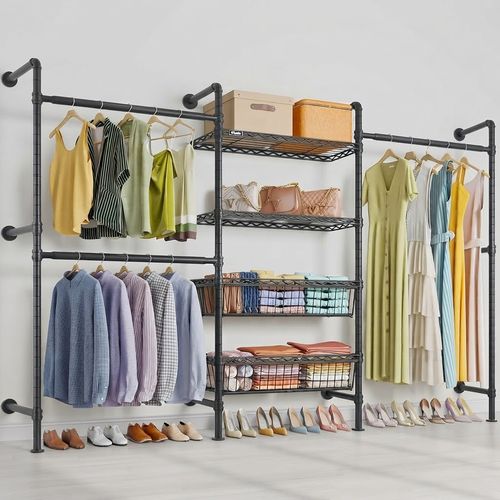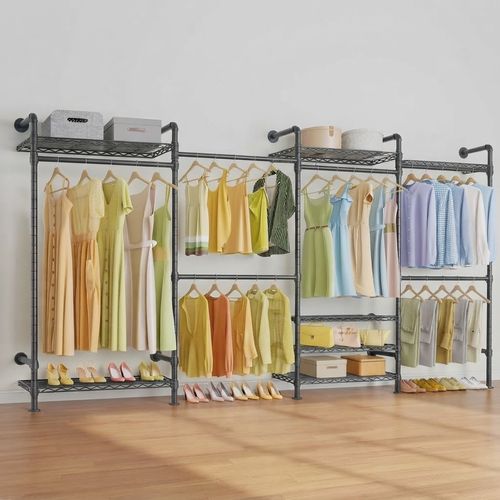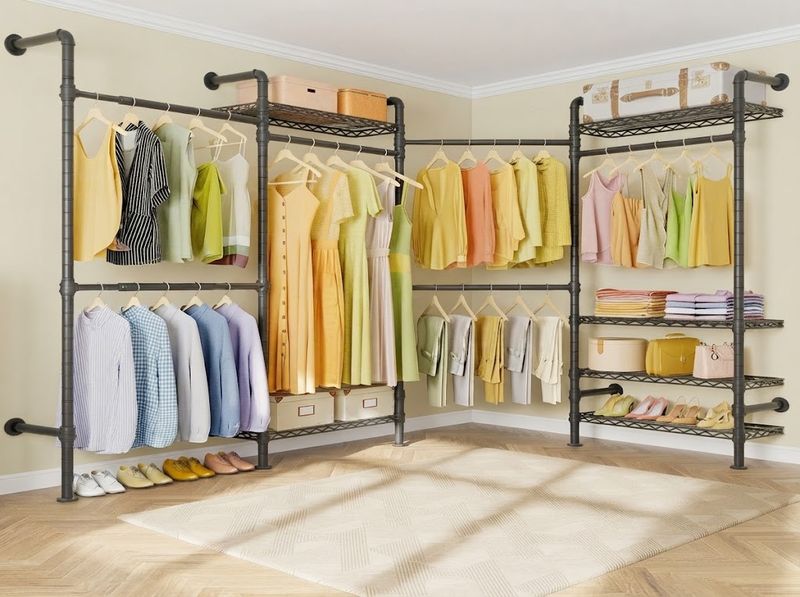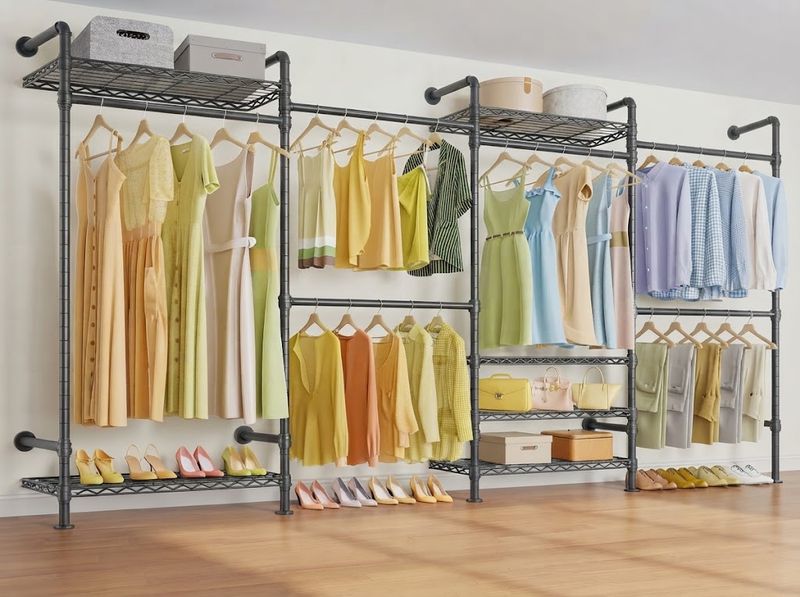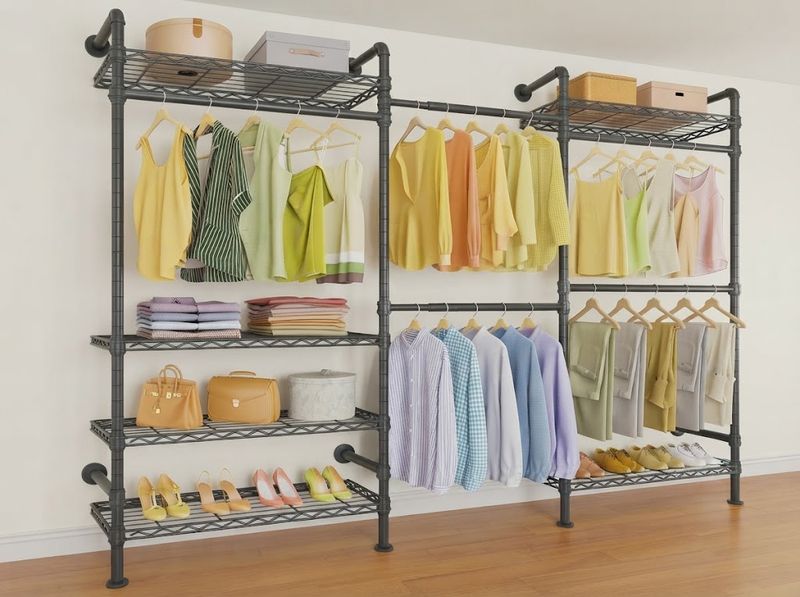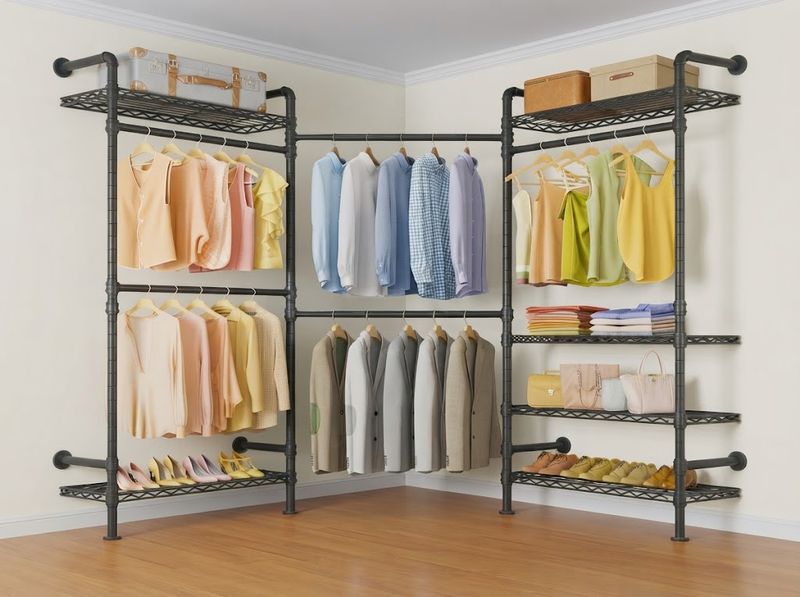
Timate Wall-Mounted Garment Rack: Modular Steel Closet Systems Rated 500 to 1,100 Lbs

Drywall doubt stops most rack purchases: Timate frames bolt into studs on 16- or 24-inch centers, and every load ceiling is published per model. The part no spec table explains sits at the corner joint, where cheap racks weld a 90-degree connector and these screw a one-piece arc instead.

Verified buyer reviews
1,150
Weighted average rating
4.55★
Published load ceilings
500–1,100 lbs
Matte black wall-mounted steel pipe closet system with hanging coats

Start With the Wall, Not the Model

Measure the wall before you order. A compact straight frame fits the 62.8 inches beside a bedroom door, while a 126-inch corner run wraps two walls into one closet. The frames come back at 4.55 stars across 1,150 verified buyer reviews, most of them from people who bolted one into their own bedroom wall. You drive lag screws into the studs you find, drop the shelves onto the tier your coats need, then pull the telescoping rods out to width.

  • Match the frame to the wall you have: a single alcove takes the compact straight unit, a dead corner takes the L4 run.
  • Run it flat down one wall or turn it through an L, then bolt a second unit onto the same line when the closet fills.
  • Bolt it to studs, or stand the X3 freestanding on its anti-tip device where a lease forbids drilling.

The Specs That Decide the Install

Worth checking on the box before the drill comes out of the drawer.

Every Part Labeled to a StepParts arrive individually wrapped and tagged against a step-by-step sheet.
Matte Powder-Coated Carbon SteelScratch-resistant on the bar where steel hangers slide every morning.
Load Ceilings Published Per ModelEach frame carries its own maximum weight figure instead of one number across the range.
30-Day Returns Through the RetailerDry-fit the rail and start a return inside the window if the width misses.

Every Timate Rack, Straight and Corner

Straight runs, corner units, and one freestanding Timate basket frame, each publishing its own load ceiling rather than a single brand number.

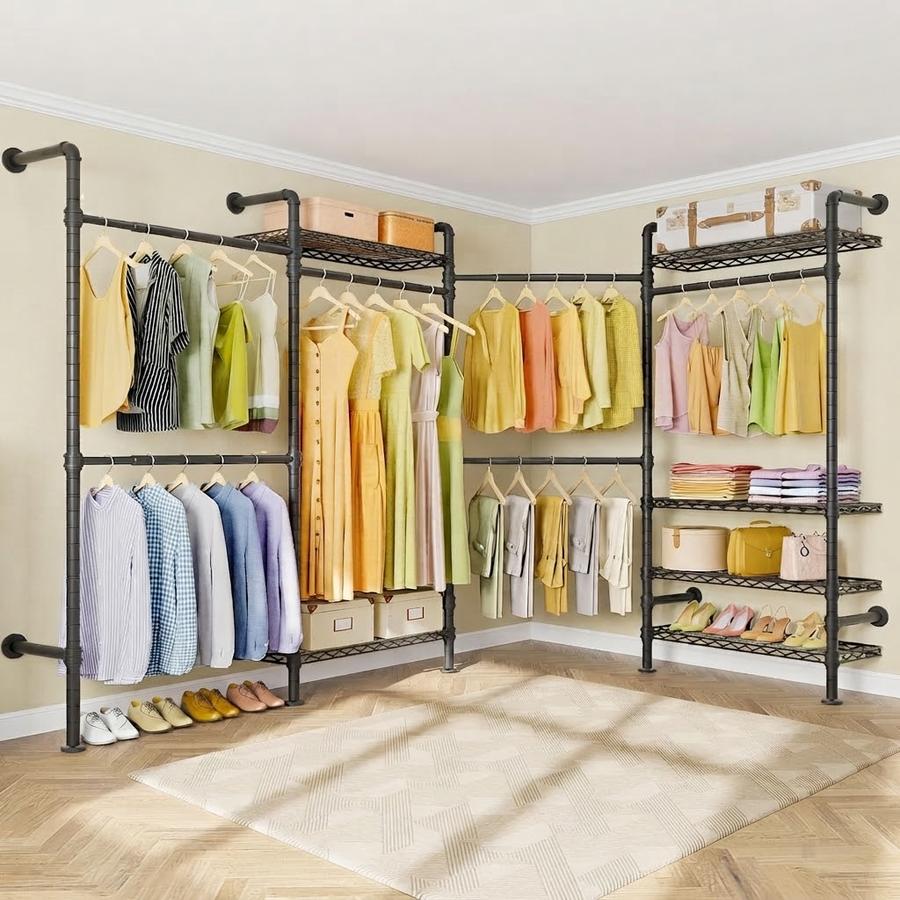
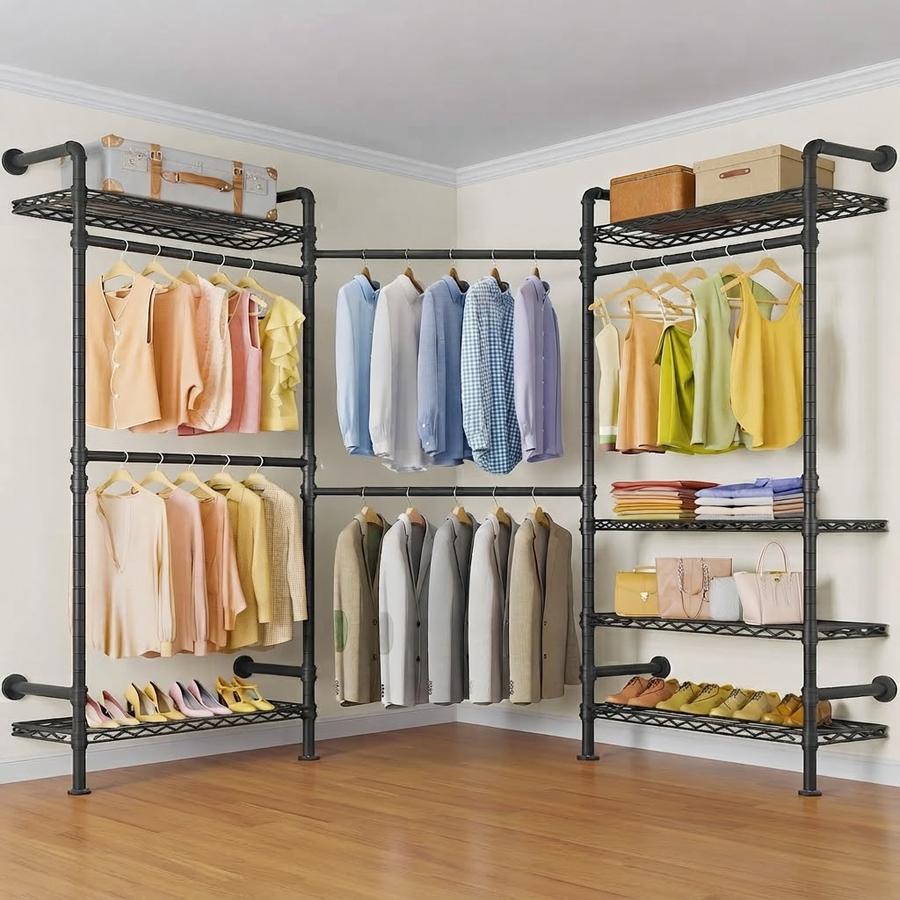
Timate L4 L-Shape Corner Garment Rack

Timate L4 L-Shape Corner Garment Rack

4.5 (149 verified reviews)

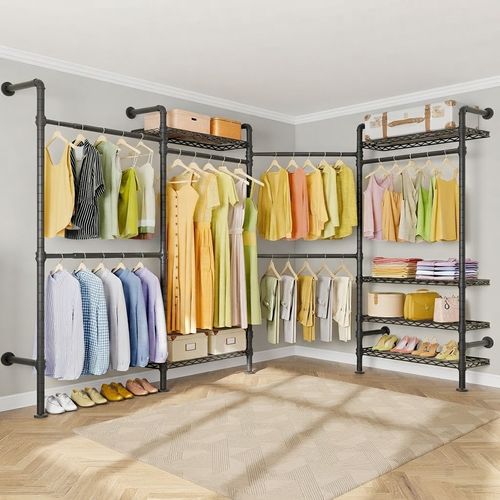
Wrap a bedroom corner from the door frame to the window and the L4 covers 126 inches of wall that held a single hook before. It carries 1,100 lbs of coats, boots, and stacked bins. The corner takes that load through a one-piece arc-shaped screw interface, so tightening the bolt closes the sleeve instead of working a welded bead. Where a fixed cabinet arrives at one width and stays there, this frame splits into two straight runs or joins a second set along the same wall. Flagship corner unit in black powder coat, shipping flat-packed with every part labeled.

  • Covers 126 inches of corner wall and carries 1,100 lbs of coats, boots, and bins
  • Corner torque closes the sleeve instead of loading a single rigid seam
  • Splits into two straight runs where a fixed cabinet holds one width for life
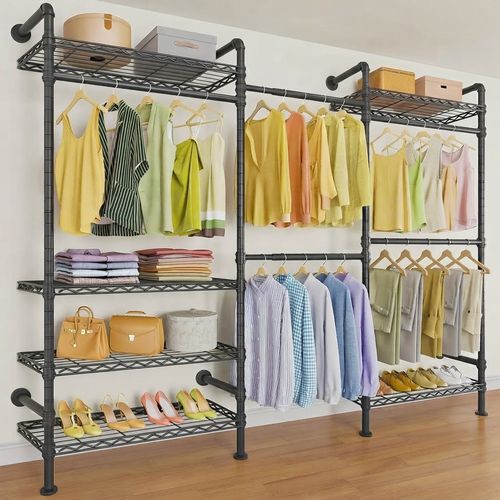
Check price
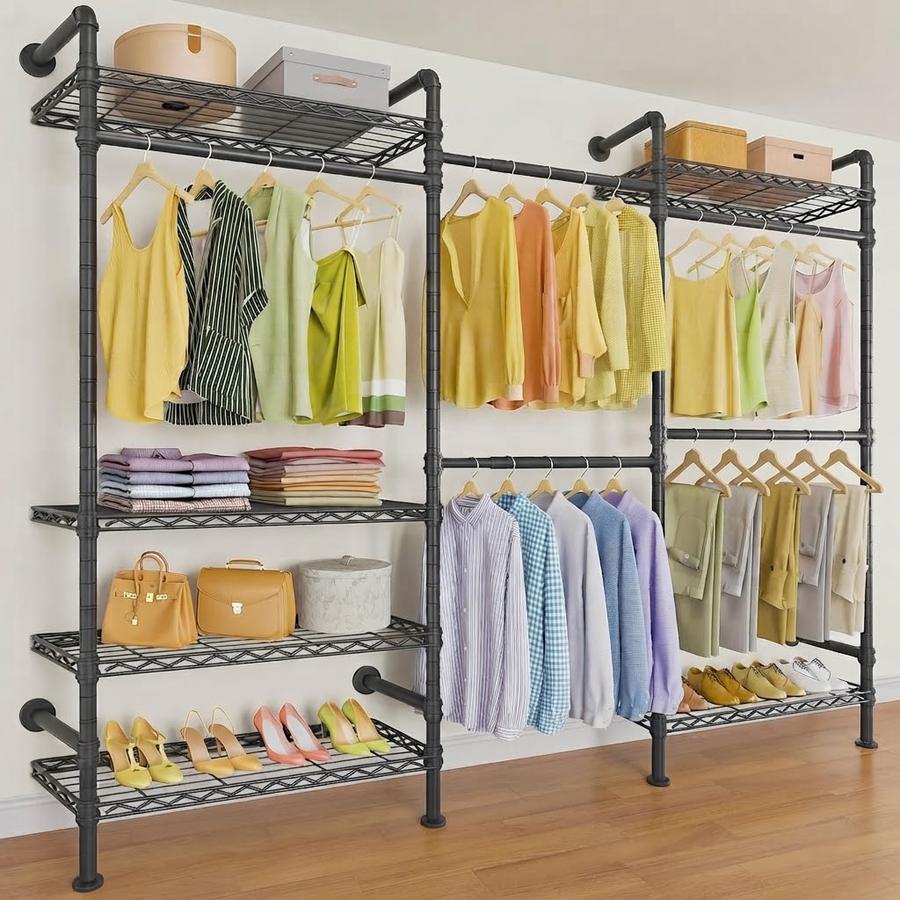
Timate F3 Wall-Mounted Garment Rack

Timate F3 Wall-Mounted Garment Rack

4.6 (496 verified reviews)

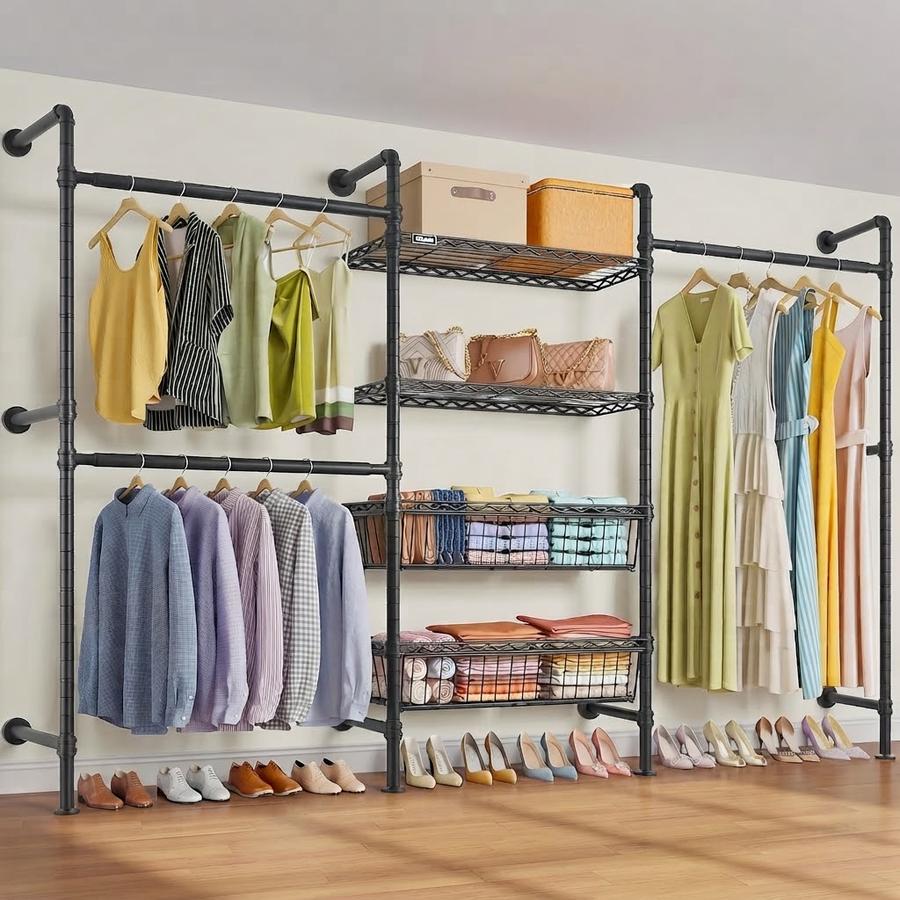
Set aside a lunch break rather than an afternoon. Labeled hardware and a step-by-step sheet put the F3 on a bedroom wall in about 30 minutes, and it holds 950 lbs once the lag screws bite into studs. Length adjusts from 74.8 to 86.8 inches, so the run stretches to the wall you actually measured instead of the wall the box assumed. Where wire shelving turns slick and grimy inside a year, the matte powder coat wipes clean with a cloth. The deepest buyer record in the range at 496 verified reviews, and it mounts to the wall or stands freestanding.

  • Stretches to the wall you measured and holds 950 lbs of loaded hanging clothes
  • Labeled parts and a step sheet keep the documented install near 30 minutes
  • 496 verified buyer reviews averaging 4.6 stars
Check price
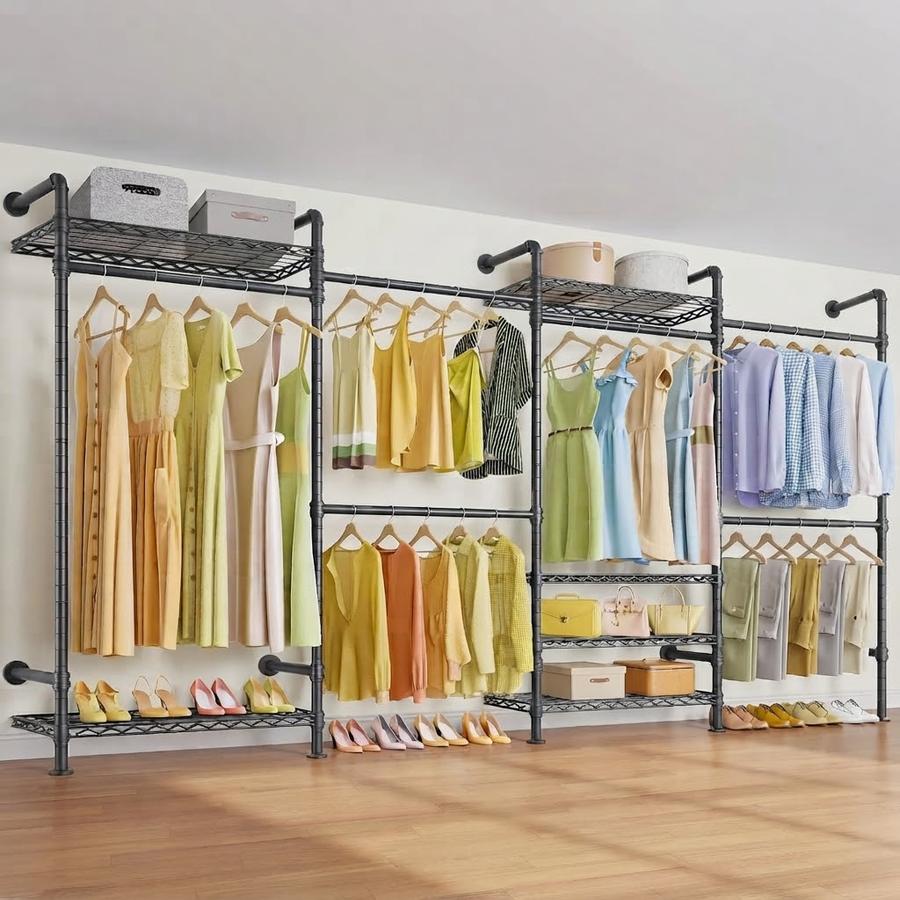
Timate F4 Expandable Wall Clothes Rack

Timate F4 Expandable Wall Clothes Rack

4.6 (219 verified reviews)

Carry the whole kit up a stairwell one-handed at 23.7 lbs, then bolt 123 inches of hanging wall that holds 1,100 lbs once it is loaded. Quick-connect fixtures drop the rails into position before the screws go in, which is what makes a solo install realistic on a run this long. Where a budget kit ships a bag of unlabeled bolts and a diagram, every part here arrives tagged to a step. The lightest frame in the range, black powder-coated, with 4 of its 6 rods expandable and shelves that reposition tier by tier.

  • Bolts 123 inches of wall at a 23.7 lb kit weight, then holds 1,100 lbs loaded
  • Quick-connect fixtures hold the rails in place before the lag screws go in
  • Every part arrives labeled where budget kits ship unmarked bolt bags
Check price
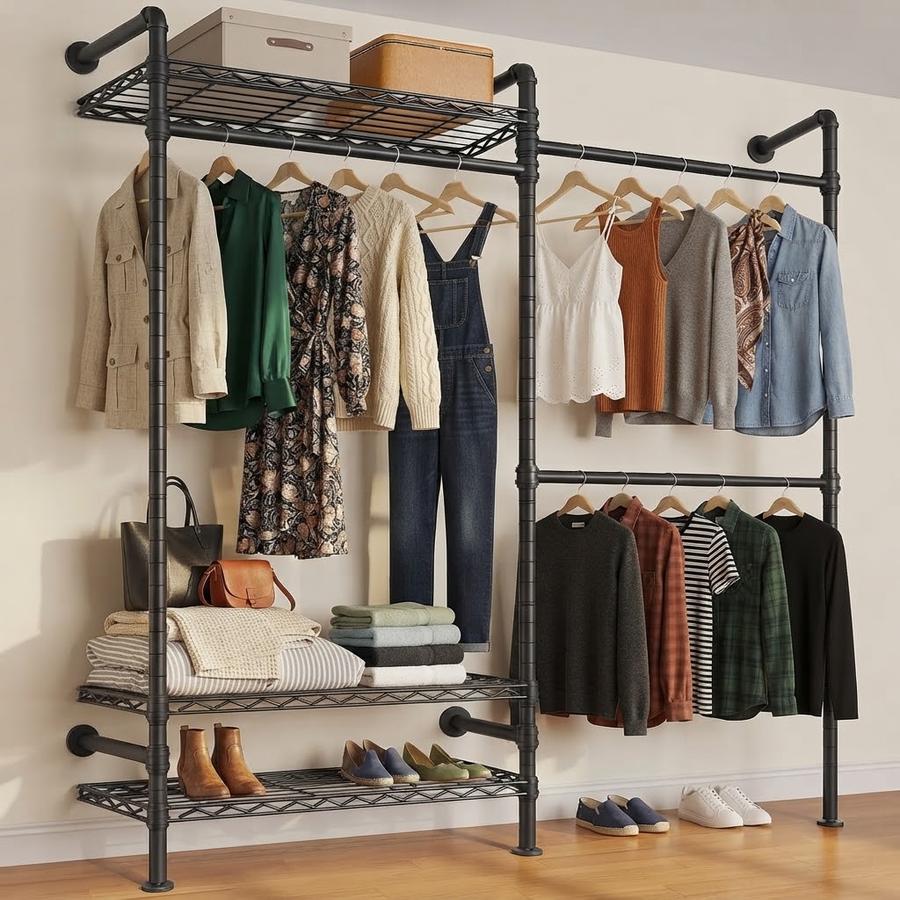
Timate F2 Compact Wall Clothes Rack

Timate F2 Compact Wall Clothes Rack

4.4 (94 verified reviews)

Fit a hanging run into the 62.8 inches beside a bedroom door, where a cabinet door could not swing and a freestanding rack would eat the floor. Two studs inside that span carry the 500 lb ceiling, and the matte-coated iron frame takes daily hanger traffic without scratching through to bare metal. Where a full-wall system demands a wall you do not have, this one asks for a single alcove and a Saturday morning. The entry point into the range: 3 shelves, 3 rods with 2 of them expandable, in the same black finish.

  • Fits a 62.8-inch alcove and carries 500 lbs on two stud contacts
  • Matte powder coat resists the hanger scraping that strips finish off bare steel
  • 94 verified buyer reviews averaging 4.4 stars on the compact frame
Check price
Timate L3 L-Shape Corner Clothes Rack

Timate L3 L-Shape Corner Clothes Rack

4.4 (131 verified reviews)

Turn a rental corner into 96.5 inches of hanging space and the L3 puts coats on two walls that shared one hook. Each leg adjusts between 54 and 62.6 inches, so an out-of-square corner still lands the rail flush against both surfaces. Where a straight rack abandons the return wall and leaves it bare, this one runs the rod around the angle. Corner unit rated 950 lbs, standing 87 inches tall with 6 shelves and 5 rods, 2 of them expandable, in matte black powder coat.

  • Spans 96.5 inches around a corner and carries 950 lbs across both legs
  • Legs adjust 54 to 62.6 inches so an out-of-square corner still sits flush
  • Runs the rod around the return wall a straight rack leaves empty
Check price
Timate X3 Freestanding Rack with Baskets

Timate X3 Freestanding Rack with Baskets

4.6 (61 verified reviews)

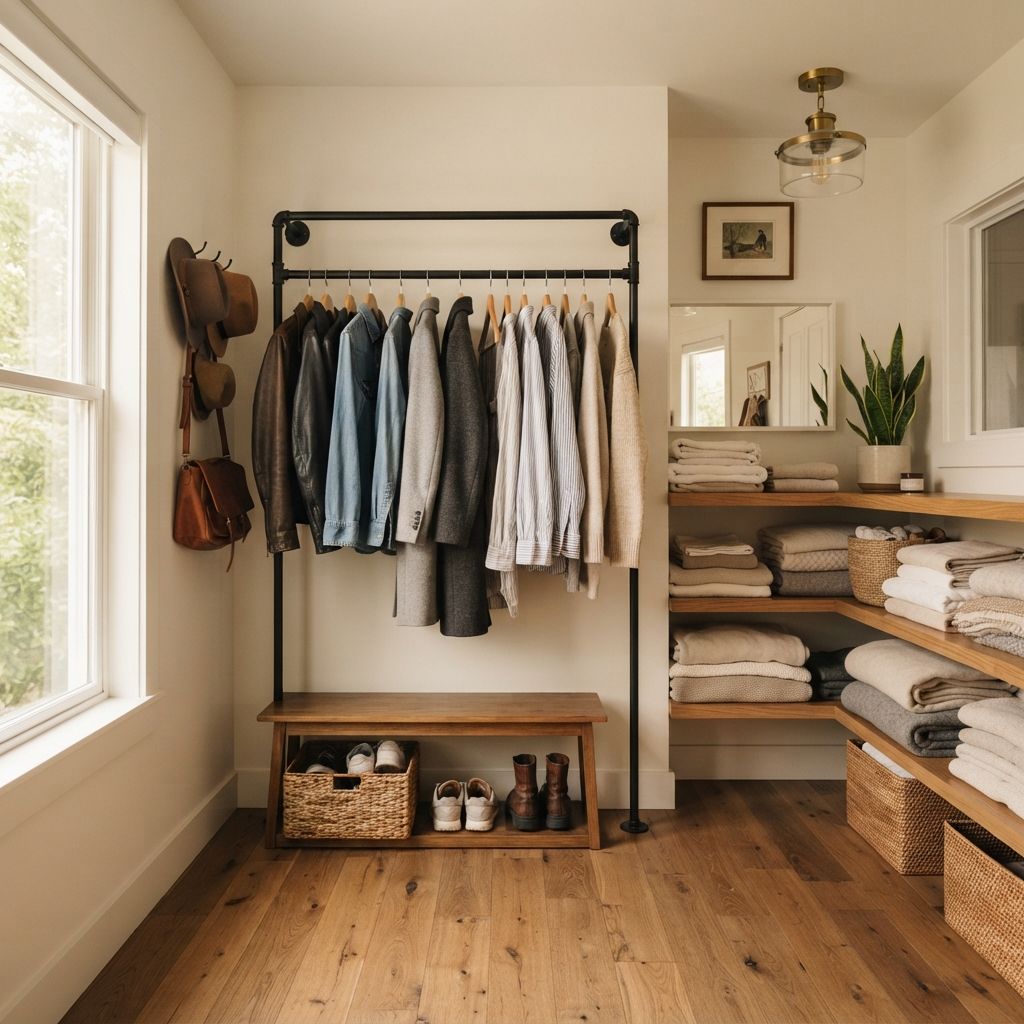
Skip the drill entirely: the X3 stands freestanding on an anti-tip device, so a lease that forbids wall holes still gets 980 lbs of rated storage. Length runs from 6 ft 3 in to 8 ft 3 in, and the deep wire baskets hold folded knits that slide off an open shelf edge. Where a wall-mounted frame commits you to one room for the length of the lease, this one assembles straight or L-shaped and moves when you do. Basket unit in black coated steel, with 3 extendable rods and shelves that reposition to the height you need.

  • Stands freestanding at 980 lbs rated capacity, no wall holes required
  • Anti-tip device plus adjustable length from 6 ft 3 in to 8 ft 3 in
  • Moves at lease end where a bolted frame stays with the room
Check price

Why the Frame Holds Where Budget Racks Give Out

Timate racks win on the parts a product photo cannot show: the corner joint, the stud contact, the shelf tier.

Screw the Corner Joint, Skip the Weld Seam

Budget pipe racks split where the 90-degree connector was welded. Load an arc-screw corner with a winter of coats and the joint pulls tighter.

Read the Ceiling for Your Exact Model

The X3 basket unit publishes 980 lbs and the compact straight frame far less, each ceiling printed against its own model instead of one brand number.

Stop Guessing Where the Studs Land

Studs that miss the bracket span kill most rack installs. Drive lag screws into the centers you find, then toggle-bolt the holes that land in bare drywall.

Wake Up to a Closet That Was a Bare Wall

Bolt a corner run up on Saturday morning, and by dinner your coats, boots, and storage bins hang on two walls that carried nothing.

Look at the Finish After a Year of Hangers

Steel hangers slide across the matte powder-coated bar every morning. Wire shelving goes slick and grimy; this coating wipes down with a cloth.

Send It Back if the Width Misses

Order the 86.8-inch F3 for a wall that measures narrower, and the retailer's 30-day return window covers the mistake before you drill.

From Stud Finder to Loaded Rod Without a Second Hardware-Store Trip

Timate documents about 30 minutes for the F3 sequence, and the mounting order below is what keeps that figure realistic.

  1. 1

    Mark the Studs

    Run a magnet or stud finder across the wall and mark every center you hit, at 16 or 24 inches.

  2. 2

    Bridge the Gaps

    Where a stud misses the bracket span, set a toggle bolt through the drywall for that hole instead.

  3. 3

    Bolt the Frame

    Drive the labeled lag screws through the rail, working from the top hole down so the frame hangs level.

  4. 4

    Set Tiers and Rods

    Slide the shelves to the tier your coats clear, then draw the rods out to the width you measured.

The Failure Points This Frame Was Designed Around

Cracked joints, sagging rods, mismatched studs, and dead corners: the problems these Timate models were drawn to remove.

Timate L4 L-Shape Corner Garment Rack

Stop the Corner Weld From Cracking Under a Full Coat Load

Welded 90-degree connectors carry the whole corner on a budget pipe rack, and the bead is where the metal opens after a year of loaded rods. Timate corners land differently. A one-piece arc-shaped screw interface wraps the joint, so torque closes the sleeve rather than working a weld line.

  • Hang a full winter coat row on the L4 corner and the arc joint takes the twist that snaps a weld bead.
  • The one-piece sleeve slides over the pipe instead of butting against it, which leaves no bead to fracture.
  • Where a cracked joint means replacing the whole frame, this one takes a wrench and about 2 minutes to re-tighten.
See the L4 corner unit
Timate F4 Expandable Wall Clothes Rack

Stretch the Rod Two Feet Without Buying a Second Unit

Fixed closet kits force a second purchase the moment a hanging run outgrows the frame, which is why the F4 ships 4 of its 6 rods expandable. Draw the telescoping section out and the run grows with the season. The wall holes stay exactly where you drilled them.

  • Pull an F3 rod to its stop and a 74.8-inch run reaches 86.8 inches without drilling a new bracket.
  • Shelves reposition tier by tier, so a boot row in September becomes a folded-sweater shelf by November.
  • Where a fixed cabinet locks its interior at the factory, this frame changes shape with a wrench.
See the F4 long run
Timate F3 Wall-Mounted Garment Rack

Match the Load Rating to the Wall You Actually Have

Two studs behind drywall decide more than the static load rating stamped on the frame, because a 950 lb ceiling assumes the anchors underneath hold. Count the studs inside your bracket span first, then pick the model. Soaked coats after a rainstorm carry weight the dry rating never counted, so leave headroom.

  • Count the wall studs inside the bracket span before ordering: two solid contacts beat a row of plastic drywall anchors.
  • A soaked wool coat can weigh close to double its dry weight, so load the rod to the season rather than the spec sheet.
  • Metal studs and lath-and-plaster walls need their own anchors; the lag screws in the box are sized for wood.
See the F3 straight unit
Timate L3 L-Shape Corner Clothes Rack

Wrap a Dead Corner Into One Continuous Closet Run

L-shape units turn the corner a straight frame abandons, which is why the L3 spans 96.5 inches across two walls. Set one leg down the long wall and the other across the return. When the closet outgrows that, a second unit bolts onto the same line.

  • Turn the corner with an L3 and two walls that shared a single hook carry coats end to end.
  • Two F-series units bolt into one continuous line, so a spare office wall converts to a walk-in over a weekend.
  • The X3 skips the wall entirely: stand it freestanding on its anti-tip device where a lease forbids drilling.
See the L3 corner unit

The Numbers Other Wall-Mount Rack Pages Skip

Load ceilings, install time, and joint construction, each figure pulled from Timate spec sheets rather than a category average.

500-1,100 lbs (model-specific)

Bolt the compact F2 into two studs and it carries 500 lbs of coats and boots. The L4 corner frame holds 1,100 lbs on the same drywall, each ceiling tied to a named model.

Most pipe-rack pages publish one blanket capacity and apply it to every size on the page.

Manufacturer spec, per-model maximum weight recommendation

4.55 stars / 1,150 reviews

The F3 straight unit carries the deepest record at 496 verified reviews and a 4.6-star average, while the newest basket unit sits at 61 and the compact frame at 94. Read the model you are buying rather than the blended average.

Competing rack pages show a single product's star count. A weighted average across a full model range rarely appears.

1,150 verified buyer reviews, weighted across every model

~30 min (F3 model)

Set aside a lunch break for the F3: labeled hardware and a step-by-step sheet put it on the wall in about 30 minutes. Corner units and the 123-inch F4 run longer, and buyers working solo report closer to two hours.

Competitor FAQ pages promise an install finishes in under an hour without ever naming a model or a figure.

Manufacturer assembly instructions (F3), cross-checked against buyer install reports

1-piece arc-screw joint (weld-free)

Look at where a rack fails rather than where it shines: on welded pipe frames the 90-degree bead opens first. Every corner unit here ships a screwed arc interface instead, a construction detail most product pages never name.

Rack pages post a headline weight number and leave corner construction undocumented, so the failure point stays hidden.

Product description, joint construction detail

3-6 shelf tiers / 2-4 rod sections

Slide a shelf up three tiers when the boots move out and folded sweaters move in. Rod sections telescope 2 to 4 times per unit, so hanging space stretches without a second frame on the wall.

Competing pages write 'adjustable shelves' and 'expandable rods' without saying how many positions a buyer actually gets.

Manufacturer spec, per-model shelf and rod configuration

12.2 in depth (every model)

Hang a bulky parka on the rod and the hanger shoulder still clears the wall, because every frame holds 12.2 inches of depth, inside the clearance installers reserve for hanger swing.

The standard depth answer gives a generic range. Few pages confirm the depth of the frame they are actually selling.

Manufacturer spec, item dimensions across every model

The Timate team in a closet fitted with wall-mounted steel racks

The Closet System Built for Walls That Were Never Meant to Hold One

Studio bedrooms rarely come with a walk-in closet, and the 8 or 9 feet of bare wall beside the door is usually all the hanging space you get. That wall is what this industrial pipe closet system was drawn for. What the star ratings never tell you is which model your studs can actually back, so start there.

You measure the run, count the studs inside the bracket span, and pick the frame that matches. One renter with a single wall and no cabinet allowance mounted the compact straight unit into two studs. A full winter wardrobe and a boot shelf went up, and the floor a freestanding rack would have eaten stayed clear. A fixed cabinet could not have been trimmed to that wall, and it would have left holes on the way out either way.

Timate ships the frames black and powder-coated, flat-packed at 23.7 to 30.6 lbs a kit. Your part is the wall, the studs behind it, and the tier heights you set on install day.

Read the full Timate story

What Buyers Report After Living With the Frame

Verified purchasers on install day, and again a year later once the rods were loaded.

★★★★★Verified Purchase

We have installed closet systems in our rental properties for years and this is the one we keep ordering. The white wire shelving we used before turned slimy and could never be cleaned back. These poles carry no plastic dip at all, so a damp cloth is the whole maintenance routine. Everything arrived labeled and packed by group, and taking it slow through the sort meant zero mistakes. If you strip a screw you can back the whole thing apart and start that section again.

Denise R. · Timate F3 Wall-Mounted Garment Rack

★★★★★Verified Purchase

Perfect for a small corner closet. Anyone calling this cheaply made has not handled it. You do need to anchor it to the wall, and I used a length of door trim screwed into the studs because my framing did not line up with the rail holes. Being able to adjust the leg width to the space was the reason I bought it. I put shelves directly above the clothing bars so the bottom row stays reachable, and left one at floor level for baskets.

Marcus T. · Timate L3 L-Shape Corner Clothes Rack

★★★★☆Verified Purchase

My bedroom has no closet, so the wall beside the door was all I had to work with. This fit that alcove exactly and I hung a full winter wardrobe plus a boot shelf on it. Two people made the install easier, mostly for holding the rail level while the first lag screws went in. The instructions show one configuration and we wanted a different one, which cost us an hour of planning. Once it was up it has not shifted at all.

Alicia P. · Timate F2 Compact Wall Clothes Rack

★★★★★Verified Purchase

The builder-grade shelf in my walk-in collapsed under too much weight, so durability was the whole reason I went looking. This took about two hours to assemble and mount, and the mounting hardware was in the box. One thing to know: decide your shelf and rod heights before you bolt the frame to the wall, because adjusting them afterwards means taking the unit back down. Plan that stage properly and it is a solid organizer I am not worried about.

Greg H. · Timate F4 Expandable Wall Clothes Rack

★★★★★Verified Purchase

My lease does not allow much drilling, so the freestanding build with the anti-tip device was what sold me. I set it up by myself in an afternoon. The extending side let me match the run to the wall rather than the other way around, and the baskets hold folded knits that always slid off my old open shelving. It looks far better than the floor rack it replaced and it does not sway when I pull a coat off the end.

Renata K. · Timate X3 Freestanding Rack with Baskets

★★★★☆Verified Purchase

Bigger than I expected and genuinely heavy duty. The pipe design gave the bedroom the farmhouse look I wanted, and wrapping the corner turned an angle that held a laundry pile into hanging space we use daily. Assembly is a two-person job and took us about four hours once we sorted parts and marked the holes. I docked a star for the instructions, which are vague enough that we did some trial and error. The finished result was worth it.

Tom W. · Timate L4 L-Shape Corner Garment Rack

Spec by Spec Against a Fixed Cabinet and a Welded Pipe Kit

Timate against IKEA PAX and generic welded pipe kits, on the criteria buyers raise before they drill a wall.

CriterionTimateBudget welded pipe kitIKEA PAX
Corner joint constructionOne-piece arc-shaped screw interface, weld-freeWelded 90-degree connectorFixed panel cabinet, no pipe corner
Static load rating500 to 1,100 lbs, disclosed model by modelSingle blanket figurePer-shelf limits, not a frame rating
Layout flexibilityStraight or L-shape, units join into one continuous runSingle fixed shapeFixed cabinet footprint
Mounting hardwareLabeled lag screws, toggle-bolt compatible spansUnlabeled generic anchorsAnti-tip strap, floor-bearing cabinet
Verified buyer rating4.55 stars weighted across 1,150 verified reviewsThin per-product review countsRated per component, not per system
Documented assembly timeAbout 30 minutes documented on the F3 straight unitNo documented figureMulti-hour cabinet build

Day 1 to Year Two on the Same Wall

Install day ends with a loaded rod, and the Timate frame keeps changing shape long after the drill goes back in the drawer.

  1. Day 1, after work

    Unpack the labeled hardware, mark two studs, and drive the lag screws. Hang the first coat before dinner, and if the width misses, the retailer's 30-day return window is still open.

  2. Week 1

    Load the rods with the season's coats and watch where the weight settles. Drop a shelf one tier when the boots stop clearing the rail.

  3. Month 1

    Draw the telescoping sections out as the hanging run fills up. A second unit bolts onto the same line when the wall allows it.

  4. Year 2 and beyond

    Check the corner bolt with a wrench each spring. A quarter turn is the whole maintenance routine where a rigid frame would already be fatiguing.

Ready for Day 1? The compact frame fits the wall beside a bedroom door — pick a size to compare specs.

What Buyers Worry About Before They Drill

Stud spacing, load claims, and cracked corners: the doubts that keep a Timate frame sitting in the cart for a week.

The Studs Are Not Where the Bracket Wants Them

Stop guessing at stud spacing. Mark every center you find inside the bracket span, then set toggle bolts through the drywall for the holes that land empty. Two solid stud contacts carry more than a wall full of hammer-in plastic anchors.

Two stud contacts carry more than four hammer-in drywall anchors

The Load Number Looks Like a Lab Number

Strip away the blanket brand rating and read the model you are buying. The F3 is rated 950 lbs against its own spec sheet, and buyers who hung two adults' wardrobes on one report no dip at the rod center.

Corner Joints on Cheap Racks Split Open

Kill the crack point before it ships. Load concentrates on a single welded bead; a screwed sleeve joint spreads it across the pipe, which is why the corner tightens under a full rod rather than opening.

Wet Coats Weigh More Than the Spec Sheet Says

Yank a soaked wool coat off the rod and you feel the difference. No published derating figure exists for wet loads, so leave headroom: load to a season's clothes, not to the ceiling printed on the box.

A Bent Rail Arrives in the Box

Toss the packaging only after you count the labeled parts against the sheet. A bent rail or missing bracket goes back inside the retailer's 30-day return window, and the exchange happens before you have drilled a single hole.

Bent parts ship back inside the 30-day return window — pick a size to compare specs.

Where the Rack Ends Up in Real Rooms

Studio bedrooms, rental corners, laundry overflow: five walls a Timate frame ends up on, and what each one carries.

The Studio Bedroom With No Closet

Mount the compact straight unit on the wall beside the door and a full winter wardrobe hangs where a laundry basket used to sit.

The Rental Corner Nobody Uses

Wrap the L3 around the angle behind the door, and shoes go on the return shelf while coats take the long leg.

Laundry Room Overflow

Hang shirts straight off the dryer on the rod and stack folded linens on the shelf above, which keeps the folding table clear.

The Office That Became a Walk-In

Join two straight units along one wall and the spare room takes a household's off-season clothes in a single weekend.

Seasonal Rotation on the Basket Unit

Drop summer knits into the X3 wire baskets in October, and the winter coats take the rods above them without a storage bin.

Questions Buyers Ask Before They Drill

Load ratings, stud spacing, toggle bolts, and returns, answered against the spec sheets.

What is a wall-mounted garment rack?

A wall-mounted garment rack is a steel pipe frame that bolts into wall studs and carries closet rods and shelves off the wall instead of off the floor. Timate builds these as modular units, straight along one wall or turned through an L, with load ceilings from 500 lbs on the compact frame to 1,100 lbs on the corner flagship.

How much weight can a wall-mounted garment rack hold?

Weight capacity depends on the model and, more importantly, on what is behind your drywall. These frames are rated from 500 lbs to 1,100 lbs of static load, published per model rather than as one brand-wide figure. That rating assumes lag screws seated in wood studs; anchors set in bare drywall carry a fraction of it, whatever the frame is rated for.

Will it hold if my studs are not exactly 16 inches apart?

Stud spacing at 16 or 24 inches on center is standard, but older homes wander. Mark every wall stud you find inside the bracket span and put lag screws into those. For rail holes that land on bare drywall, use toggle bolts rather than hammer-in plastic anchors. Two solid stud contacts plus toggles hold better than four anchors in drywall alone.

Is there a warranty on the frame?

No manufacturer warranty term is published for these racks, so treat the retailer's standard 30-day return window as the coverage you actually have. Inspect the parts against the packing sheet the day the box lands, dry-fit the rail against the wall, and start the return inside that window if anything arrives bent or short.

What happens if the unit does not fit my closet width?

Measure the wall before you drill, because that is the point of no return. Most models adjust: the F3 runs 74.8 to 86.8 inches, and the L3 legs move between 54 and 62.6 inches. If the frame still misses, it goes back through the retailer's 30-day return window as long as you have not mounted it.

Can I mount a closet rack without hitting a wall stud?

Bare drywall will not carry a loaded closet rod on plastic anchors. Where studs fall outside the rail holes, toggle bolts spread the load across the back of the drywall and hold far better. The stronger fix is a length of plywood screwed across the studs first, with the rail bolted into that board wherever you need a hole.

What size toggle bolt do I need for a heavy closet rack?

Toggle bolts in the 3/16 in to 1/4 in range are what installers reach for on loaded garment racks, matched to a drywall thickness of 1/2 in or 5/8 in. Buy the length that lets the wings open fully behind the board. Toggles carry the holes that miss studs; they are a supplement to stud contact, not a replacement for it.

How long does installation take?

The F3 straight unit documents about 30 minutes in its assembly instructions, and that figure assumes the studs are already marked. Corner units and the long straight frames take longer in practice. Buyers working alone on the biggest runs report closer to two hours once shelf placement and marking are counted, and a second person makes the long rails easier.

Is a wall-mounted rack better than a freestanding one?

Wall mounting lifts the whole wardrobe off the floor, which matters in a studio where every square foot is doing a job. It also removes the wobble a floor rack develops under load. Freestanding wins where a lease forbids drilling. The X3 covers that case, standing on an anti-tip device with 980 lbs of rated capacity.

How does this compare to IKEA PAX?

IKEA PAX is a floor-standing cabinet system that arrives at fixed widths and cannot be trimmed to an odd wall. These racks bolt to the wall, adjust in length, and turn a corner where a PAX frame would block a door swing. PAX gives you doors and drawer fronts; a pipe rack gives you an open run and a wall you can reconfigure later.

How is this different from a cheap discount-marketplace pipe rack?

The visible difference is the corner. Budget pipe racks weld a 90-degree connector, and that bead is where cracks start under a loaded rod. These frames use a one-piece arc-shaped screw interface instead, and each model publishes its own static load rating with labeled mounting hardware in the box rather than a bag of generic anchors.

Is 12.2 inches of depth enough for winter coats?

Depth holds at 12.2 inches across every model, which clears a hanger shoulder and a bulky parka without the sleeve rubbing the wall. Full-depth built-in closets run deeper because they enclose the clothes behind a door. On an open wall rack, that extra depth mostly adds projection into the room rather than usable hanging space.

Still deciding? Compare the corner and straight frames side by side.